


Laser Vision Correction
I want to get rid of glasses and contact lenses.
01
Svjetlost. The best choice for your eyes!
Trust that starts with us
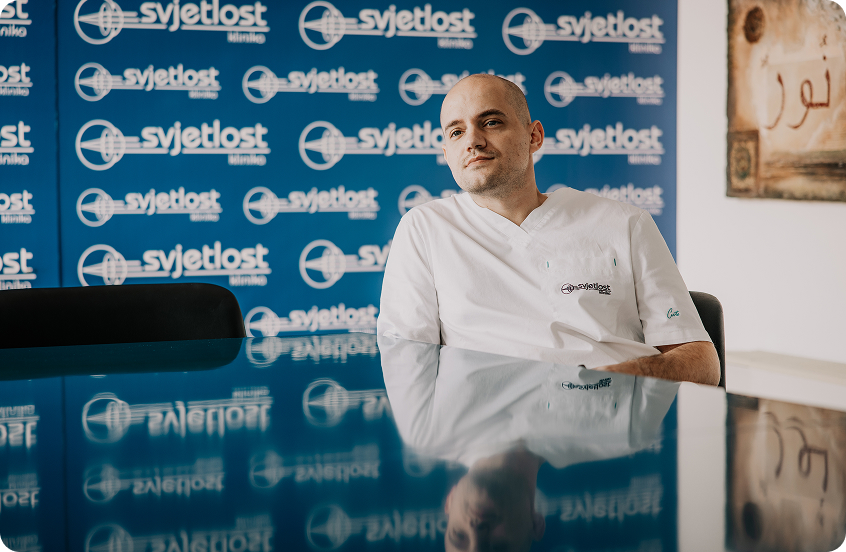
At Svjetlost Eye Clinic, we believe that we should offer patients only what we would choose for ourselves and our loved ones. That is why laser vision correction is performed by doctors who have themselves undergone the same procedure – as patients.
Among them are Ivan Gabrić, MD, Professor Maja Bohač, MD, PhD, and Mateja Jagić, MD, PhD, as well as numerous other members of the Svjetlost team who have placed their trust in our doctors, expertise, and technology.
When doctors choose a procedure they perform daily, it is a strong confirmation of trust in the safety of the procedure, the expertise of the team, and the quality standards behind every procedure at Svjetlost Eye Clinic.
Technology we create for the future
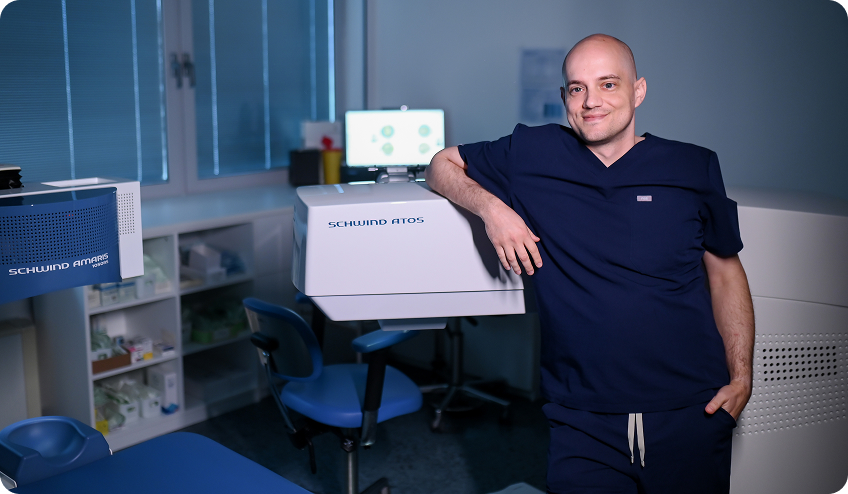
The team of doctors at Svjetlost Eye Clinic, led by Ivan Gabrić, MD, actively participates in the development of technologies that shape refractive surgery.
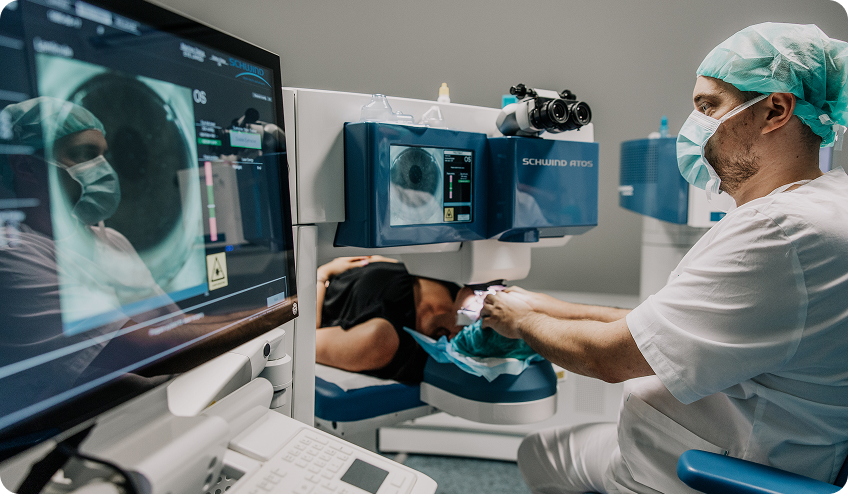
SCHWIND eye-tech-solutions selected Svjetlost Eye Clinic for the development of the ATOS laser, while Johnson & Johnson chose Svjetlost Eye Clinic as one of five clinics worldwide for the development of the ELITA laser.
Using the ELITA device, Ivan Gabrić, MD, was the first in the world to perform a low-energy SILK procedure, setting new standards in lenticular laser surgery.
ATOS and ELITA technologies are now used in clinics worldwide, and the DNA of Svjetlost is embedded in technology that changes patients’ lives on all continents.
Precision begins with an individual approach
Every eye is unique. That’s why every treatment plan is tailored specifically to you. At Svjetlost Eye Clinic, every procedure begins with understanding your eyes, your needs, and your lifestyle. With a comprehensive range of vision correction methods – SmartSight, SmartLASIK, SmartSurface, SmartLASIK Custom Eyes, PresbyMAX and phakic intraocular lens implantation – we select the solution that is best suited to you. From your initial examination through to a full recovery, we are by your side every step of the way.
Innovative solutions
Where others stop, we continue to seek solutions.
Years of experience, advanced technology, approach, and range of services allow us to address even complex cases of refractive surgery.
Our goal is not to apply one method to all, but to find the most effective solution even for the most complex cases – always focusing on safety, precision, and long-term quality of vision.
02
Do you want clear vision without the limitations of glasses and lenses?
Choose laser vision correction.
Laser vision correction corrects the optical imperfection of the eye.

Nearsightedness
Nearsightedness (myopia) - you see clearly up close, while distance vision is blurred. In this case you need a minus lens, so that the image falls precisely on the retina and is sharp.

Farsightedness
Farsightedness (hyperopia) - close vision is blurred and the eyes tire easily. In this case you need a plus lens, so that the image falls precisely on the retina and is sharp.

Astigmatism
Astigmatism - vision is blurred, and you see a shadow at all distances due to irregular corneal curvature.
03
Is this procedure for me?
If you no longer want to “rent” your vision and are tired of glasses and lenses, we have a solution for you!
Most people over 18 with a stable prescription for at least a year are candidates for laser vision correction.
Is your vision blurred without glasses or contact lenses?
Does your eyesight limit your daily activities?
Are you over 18 years old?
Do you have a healthy cornea?
During your first examination, our specialists carefully assess the health of your eyes, the structure of your cornea, and your visual needs.
The goal is not “laser for everyone,” but the right solution for you. If you are among the small number of patients who are not candidates for laser surgery because of thin corneas or a very strong prescription, we will recommend other solution, such as the implantation of intraocular (implantable) lenses.
04
From examination to recovery within 24 hours!
Examination for laser vision correction
The eye must be healthy; that is, any irregularities, diseases, or conditions must be either cured or well-controlled before the procedure.
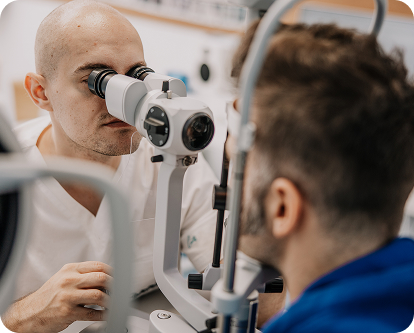
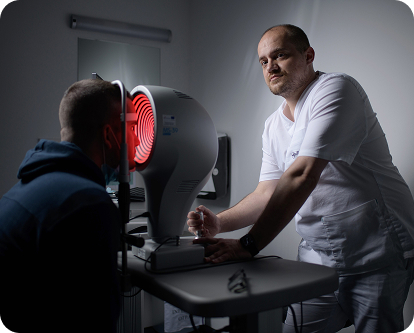
The examination begins with corneal imaging (the front transparent part of the eye), which analyzes its relief and thickness. Then, higher-order aberrations are measured, i.e., a detailed assessment of the eye as an optical system is performed to detect even the most subtle irregularities affecting vision quality.
Ivan Gabrić, MD
Ivan Gabrić, MD
This is followed by a visual acuity check and pupil dilation for a more precise, objective assessment of your refraction. This rules out accommodation, which in some patients can give an inaccurate reading.
As part of the examination, the following are additionally performed:
Intraocular pressure measurement
Tear volume assessment
Examination of the fundus, including the optic nerve, macula, and retinal periphery
If any irregularities are observed, diagnostics are further expanded according to the findings. The examination lasts between 90 and 120 minutes.
If you wear contact lenses, they must be removed before the examination:
- soft lenses at least 3 full days prior
- (semi-)hard lenses at least 14 full days prior
Due to pupil dilation, vision may be slightly blurred for a short time after the examination.
During the examination for laser vision correction, and following agreement with the doctor, if there is a need for other types of drops, vision may be slightly blurred for up to 48 hours after the examination.
05
Methods of laser vision correction
Laser vision correction refers to procedures that reshape the cornea – the clear front surface of the eye – with a laser, in order to remove or reduce refractive error, do away with glasses and contact lenses, and improve visual acuity.
Today, there are several methods of vision correction today, grouped by how deep in the cornea the procedure is performed.
The choice of method is personalized and tailored to you!

SmartSight
SmartSight (lenticular surgery) is the future of laser vision correction.

SmartLASIK
SmartLASIK is the gold standard of refractive surgery, where the procedure is performed with the help of two lasers.

SmartLASIK Custom Eyes
SmartLASIK Custom Eyes is based on the unique characteristics of each eye.

SmartSurface
SmartSurface is an innovative, fast, efficient and contactless laser vision correction procedure.

PresbyMAX
PresbyMAX is a special method of laser presbyopia correction performed as an addition to the SmartLASIK laser vision correction method.
SmartSight method
Lenticular surgery – the 3rd generation of laser vision correction is the future of laser vision correction.
The SmartSight method is the commercial name for the 3rd generation of laser vision correction (lenticular surgery) by the German company SCHWIND eye-tech-solutions. It is performed on the newest and most advanced ATOS laser, developed with the team of doctors at Svjetlost Eye Clinic, led by Ivan Gabrić, MD, who is the leading physician for the application and development of the SmartSight method in daily clinical practice.
Professor Maja Bohač, MD, PhD performed the first SmartSight procedure in Europe.
ADVANTAGES OF THE SMARTSIGHT METHOD:
- Safest method
- Minimally invasive procedure
- Lowest risk of dry eye development
- Good vision a few hours after the procedure
- No activity restrictions the very next day
About the SmartSight method
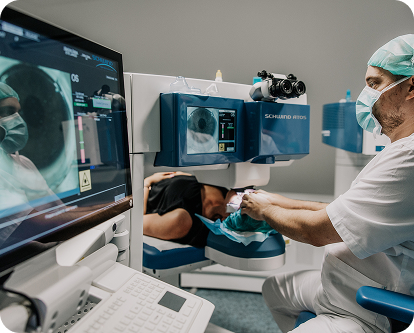
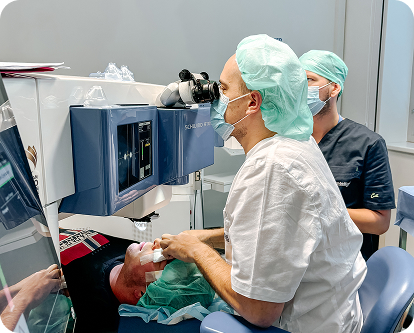
In the SmartSight procedure, the SCHWIND ATOS device creates a predefined lenticule in the intrastromal tissue of the cornea, and makes small peripheral incisions in the top corneal layer for lenticular access. This minimally invasive procedure results in fewer nerve transections in the cornea surface reducing the potential for postoperative incidence of dry eye. After lasering, the surgeon, looking through the microscope included in SCHWIND ATOS, can easily remove the lenticule through the small access incisions. SmartSight uses no corneal flap of any kind, and there is no laser ablation like there is with excimer lasers.
SmartSight is the latest generation of laser vision correction and is ideal for patients who want a life without limitations.
Ivan Gabrić, MD
Ivan Gabrić, MD
Procedure steps

Lenticule creation
To correct the refractive error (vision problem), the femtosecond laser creates a small lens-shaped piece of tissue (lenticule) within the cornea.

The incision
The laser then proceeds to create a small opening for removal of the lenticule. The total duration of the process is 30 seconds and is completely painless.

Lenticule removal
The surgeon removes the lenticule through a 3-millimeter opening, correcting the vision. The small incision heels on its own within 48 hours. Thanks to the minimally invasive nature of the procedure, patients quickly and easily return to all life activities.
SmartLASIK method
About the method
SmartLASIK, the gold standard of refractive surgery, where the procedure is performed with the help of two lasers. First, a femtosecond laser is used to cut a corneal flap, which is folded to the side. An excimer than models the corneal tissue underneath. After excimer lasering the flap is folded back into place, where it adheres automatically. The advantage of this procedure is that it corrects every kind of refractive error, with rapid recovery of visual acuity.
Procedure steps

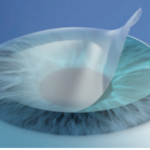
Flap creation
The Femtosecond laser is used to create a flap bed. An untouched hinge keeps the flap attached to the cornea.

Lifting the flap
The prepared flap is folded back like the page of a book, exposing the inner corneal tissue to be treated.

Reshaping
Switching to the Excimer laser, the cornea is then reshaped and the refractive error corrected.
The fold-back
The flap is folded back to its natural position and covers the treated area once again.
Personalized vision correction, SmartLASIK Custom Eyes (Peramis, MS 39)
“Custom” means that each treatment is specifically designed for your vision. Custom Eyes is based on the unique characteristics of each eye. Every eye has a series of unique optical irregularities, known as higher-order aberrations, which can be compared to a fingerprint. These irregularities can cause:
Reduced contrast sensitivity
Poorer night vision
Glare, shadows, and halos
The software program takes these irregularities into account and corrects them along with the refractive error, to improve postoperative vision quality. Custom Eyes® with the SCHWIND AMARIS device uses wavefront technology, which enables an advanced, individualized approach to laser vision correction. The diagnostic procedure is unique, just like your eyes.
Treatment planning includes data from the most modern high-resolution diagnostic devices, enabling maximum personalization and precision for each procedure. This method achieves sharp vision that is sometimes impossible to achieve with standard lasers, glasses, which correct only the refractive error.
With SCHWIND lasers, it is possible to choose between:
- Corneal wavefront guided – correction of corneal irregularities only, ideal for scars or local deformations
- Ocular wavefront guided – correction of the entire eye, ideal for night vision disturbances not caused by retinal diseases
Standard treatments are suitable for most people with very small aberrations. For patients with additional visual disturbances, Custom Eyes provides significantly better vision quality and results than standard vision correction.
SmartSurface method
About the method
The innovative SmartSurface laser vision correction procedure is fast, efficient, and contactless. Is is completely touch-free.
The procedure combines the advantages of the proven SCHWIND SmartSurface ablation method and the revolutionary SmartPulse technology. The result is clear vision without compromise.
The SCHWIND AMARIS laser corrects vision through the top layers of the cornea, without suction, flap, or incision, and without the use of alcohol.
SmartSurface is non-invasive, safe, gantle, and stress-free for the patient.
It is suitable for patients who have a high level of fear of vision correction procedures, for mild corneal irregularities, thin corneas, and for scars on the eye surface.
Procedure steps

Reshaping corneal tissue
In just one step, the excimer laser removes the top layer of the cornea (epithelium) and reshapes the corneal tissue below.

Bandage placement
The surgeon places a bandage/therapeutic lens over the eye to protect it during the regeneration process. The lens is extremely effective as a barrier against external influences.

Removing the bandage
The epithelium fully regenerates within 3 to 5 days. After re-epithelialization, i.e., healing of the superficial layer of the eye, the surgeon will remove the bandage lens.
The surgical procedure itself is not painful, but postoperative recovery with this method can be uncomfortable. As a rule, recovery of visual acuity also waits until the epithelium heals, and complete stabilization of vision quality often takes several weeks.
06
Procedure and recovery
What does the procedure involve?
Laser vision correction is a completely painless procedure performed under local (topical) anesthesia.
The procedure is performed as an outpatient treatment. The procedure itself lasts 5-10 minutes per eye, depending on the method. During the operation, the eye is held open with a special eyelid holder or blepharostat, which prevents blinking, and the patient is awake throughout and follows the doctor’s instructions. Modern lasers are equipped with a multi-dimensional eye tracking system, ensuring that accidental movements of the patient’s body or eye do not affect the safety and precision of the procedure. The patient goes home after the procedure.
What does recovery look like after laser vision correction?
Postoperative recovery depends on the vision correction method. On the first day after surgery, the image is usually blurry (as if looking through water), but significant clearing of the image occurs the next day.

SmartSight
The fastest vision recovery is with the SmartSight method, where good vision is standard a few hours after the procedure, and the very next day, the patient enjoys daily activities without restrictions.

SmartLASIK
With the SmartLASIK method, recovery is measured in days. Patients can return to most usual daily activities within a day or two. It is important to avoid eye contact with any potentially unclean surface (fingers, tap water) for several days. With SmartLASIK, washing eyes with tap water is not recommended for 3-4 days. Within a week of the surgical procedure, it is possible to return to all life activities.

SmartSurface
With the SmartSurface method, full vision recovery is somewhat slower and depends on the speed of eye surface healing; it takes five to seven days to return to daily activities. It is important to avoid eye contact with any potentially unclean surface (fingers, tap water) for several days. Washing eyes with tap water is not recommended until the eye surface heals and the therapeutic contact lens is removed. Within a week of the procedure, it is possible to return to all life activities.
After all procedures, it is mandatory to instill antibiotic/corticosteroid drops for two weeks and artificial tears for at least one month.
Follow-up examinations
At Svjetlost Eye Clinic in Zagreb, laser vision correction procedures are performed every day of the week.
The first follow-up examination is performed the day after the procedure, with recommended further check-ups after one week and one month, and later if necessary. All check-ups within one year of the procedure are included in the procedure price.
07
Another method of vision correction: phakic lens implantation
Refractive surgery
When laser is not a solution, there is the method of phakic intraocular lens implantation.
When laser is not an option because the prescription is very strong, or because the examination reveals that the corneas (the front transparent part of the eye) are too thin for laser action or have irregularities that increase the risk of complications, there is the possibility of implanting phakic lenses (Implantable Collamer Lens – ICL, Verisyse, Veriflex) into the eyes.
Phakic lenses are implanted in the anterior part of the eye (in front of or behind the pupil), without removing the natural lens, and function like a contact lens in the eye, except that the patient has no worries about them and does not feel them.
Eye surgery is performed through small incisions that usually do not even require suturing. The surgical procedure is almost entirely free of complications and is extremely gentle on all eye structures (no eye structure is removed).
It is particularly suitable for young people (between 20 and 50 years old) who still have the ability of eye accommodation, i.e., the ability to adjust image focusing for both distance and near vision.
The procedure is also reversible, meaning the lens can be removed from the eye without damage to the eye (in case of diopter increase and the need for a stronger lens or the arrival of new, significantly better technology). There are several types of these lenses (Implantable Collamer Lens-ICL, Verisyse, Veriflex) covering a range from -23 diopters to +21 diopters, with up to 6 diopters of cylinder.
Types of phakic lenses
Implantable Collamer Lens (ICL)
These lenses are implanted behind the pupil (in the posterior chamber of the eye, between the iris and the natural lens). They are currently considered the highest quality solution for individuals who are not suitable candidates for laser vision correction, and they come in a range from -0.50 to -18 and +0.50 to +8, and also correct astigmatism up to 6 diopters. Compared to other generations of phakic lenses, they have a larger optic and are also suitable for individuals with large pupil diameters. Due to the lens’s position in the eye, it has also been observed that in individuals with high myopia, they significantly improve visual acuity compared to glasses and contact lenses. The lens is made of biocompatible material, does not cause an immunological reaction in the eye, and also has anti-reflection and UV protection properties.
Verisyse/Veriflex
These lenses are implanted in front of the pupil, on the iris, and provide excellent vision quality to patients with a very strong prescription. Today they are implanted when the prescription amount is greater than the ICL lens range covers, or in patients whose eye structure cannot hold a lens behind the pupil. These lenses have been on the market for over 20 years, backed by extensive global experience indicating excellent results and procedure stability.
08
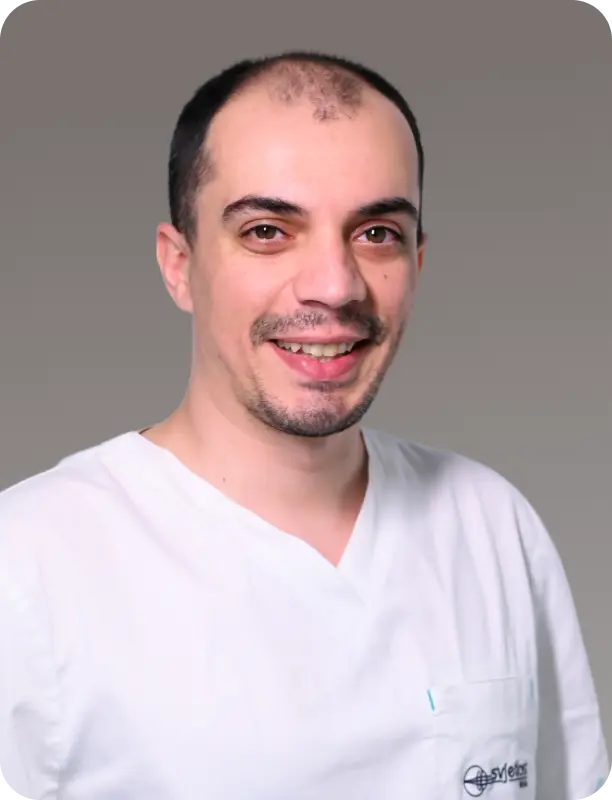
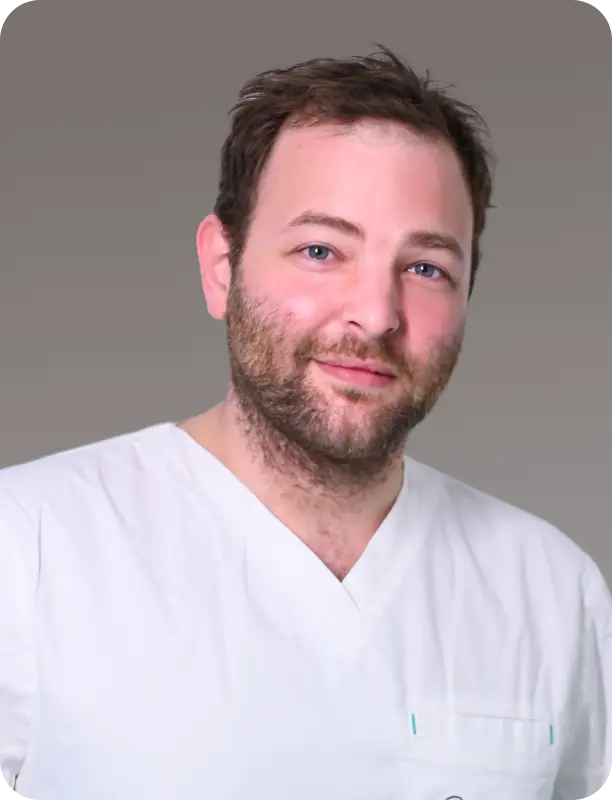
Your medical team – our physicians
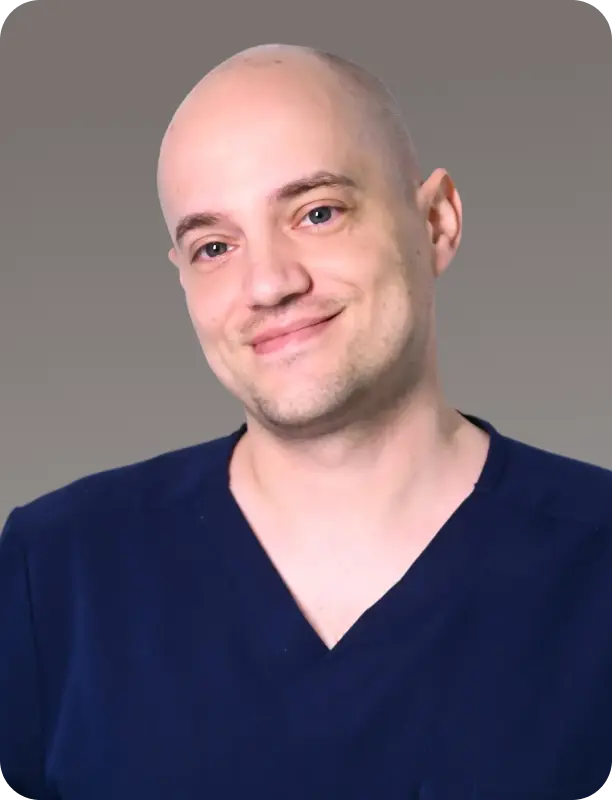
Member of the Management Board

Ophthalmologist
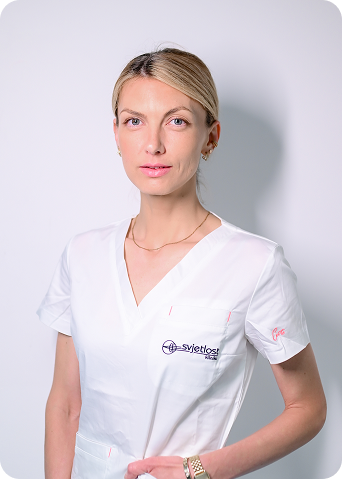
Ophthalmologist
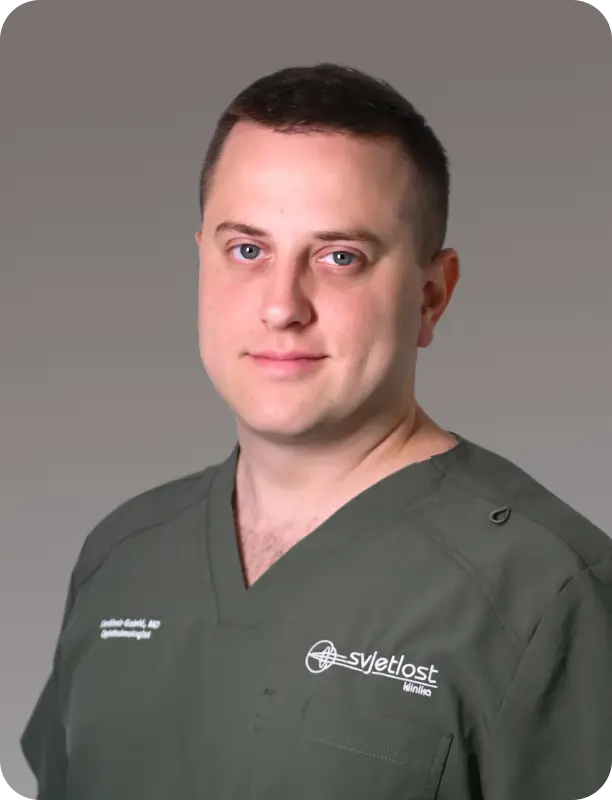
Member of the Management Board
Ophthalmologist

Ophthalmologist
Ophthalmology Resident
Ophthalmology Resident
09