



Strabismus Surgery
I think one of my eyes turns in or out.
01
What is strabismus?
Strabismus, or squint (crossed eyes), is when the two eyes do not point in the same direction. As a result, each eye creates a different image that the brain cannot merge into a single whole. In healthy eyes, both eyes are directed toward the same point, and their movements are fully coordinated.
Strabismus can be congenital or develop as a result of certain diseases and injuries. In children, it is most often present from birth or appears at an early age and can negatively affect vision development. In adults, it often occurs as part of other diseases, such as stroke, brain tumor, thyroid disease, diabetes, multiple sclerosis or myasthenia gravis, and can also occur after head or eye injuries.
One of the most important characteristics of strabismus in children is that although the eye deviates and both eyes do not look at the same point, the child does not experience double vision. The child’s brain is able to adapt and unconsciously suppresses the image that does not fit and uses only the one that does. Although this adaptation allows the child to avoid double vision, it is actually very dangerous because the brain neglects one eye, which is gradually excluded from the visual process, potentially leading to the development of amblyopia, or lazy eye, in which the brain stops using one eye and to permanent loss of quality binocular and stereoscopic vision.
The most common eye position deviations are inward, esotropia, or outward, exotropia, while vertical forms of strabismus in which the eye deviates upward or downward are less common. Strabismus is often associated with other visual disorders, such as amblyopia, refractive errors, and nystagmus.
Strabismus surgery corrects the position of the eyes, with both cosmetic and psychosocial benefits. In most cases, the procedure also brings functional improvement, such as easier viewing without fatigue, reduced headaches and strain, and better creation of quality three-dimensional images. The development of binocular or stereovision after surgery depends on the type of strabismus and the state of binocular vision before the procedure. The procedure is intended for both children and adults and contributes to greater confidence in daily activities.
At Svjetlost Eye Clinic, we perform all types of strabismus surgery, including horizontal and vertical forms, paresis, nystagmus, and double vision, with minimal waiting time. We apply modern surgical methods and techniques used by leading global centers, with many years of experience and a large number of successfully performed procedures.
Svjetlost Eye Clinic has worked for many years with the Department of Ophthalmology at LMU University Hospital Munich and Professor Oliver Ehrt, one of Europe’s leading strabismus specialists and president of the European Strabismological Association.
02
Is this procedure for me?
Strabismus surgery can be an effective solution for children and adults, depending on the type and cause of the disorder. After a detailed examination, the best treatment approach is determined.
This procedure may be a good choice if you:
notice deviation of one or both eyes
have difficulty focusing or coordinating your gaze
experience double vision or eye fatigue
tilt or turn your head to see more clearly
want functional and aesthetic improvement of eye position
seek a permanent solution with an individually tailored approach
03
Strabismus examination
A strabismus examination includes a detailed assessment of eye position, movements, and coordination. The goal of the examination is to determine the type and cause of strabismus and identify the most appropriate treatment method.
Orthoptic assessment
A strabismus examination differs from a standard ophthalmological examination because it focuses on assessing binocular function and eye position.
During the examination, the following are assessed:
- stereovision and binocular vision using stereo tests
- angle of strabismus at near and distance
- eye position in different gaze directions
- eye movements
- ductions (movements of each eye separately)
- versions and vergences (coordinated movements of both eyes)
If surgical treatment is planned, prism testing is also performed. This allows us to simulate the expected eye position after surgery and assess whether there is a risk of double vision after the procedure, which is particularly important in planning surgical treatment.
Ophthalmological Examination
In addition to orthoptic assessment, the examination includes a complete ophthalmological evaluation:
- determination of refractive error and visual acuity
- measurement of intraocular pressure (tonometry)
- examination of the anterior segment of the eye with a biomicroscope
- assessment of the tear film (Schirmer test)
- pupil dilation for refraction determination
- examination of the fundus and posterior segment of the eye
Based on all findings, the need for further treatment is assessed and an individual therapy or surgical plan is developed.
04
Procedure and recovery
Strabismus in children interferes with healthy visual development, which is why it is important to begin treatment as early as possible. It is often combined with other visual disorders in children, and treatment must be tailored to each patient. In children, the most common consequence of strabismus is amblyopia, which occurs because the brain neglects the deviating eye. Amblyopia can only be treated during childhood, which is why the stronger eye is patched early on, forcing the child to use the weaker one.
Each eye is moved by six muscles, and the impulse for movement comes from the brain and is normally the same for both eyes. Coordinated eye movements achieve perfect cooperation of both eyes, enabling the development of binocular vision, i.e., cooperation when looking with both eyes at the same time. In this process, two slightly different images merge in the brain, creating a single three-dimensional image (stereo, 3D vision). If both eyes are not aligned or the motility of one eye is restricted for some reason, a person experiences double vision or diplopia.
This happens because the brain cannot merge two different images into one whole. Adults usually find this situation difficult to tolerate and often instinctively close one eye to be able to perform daily activities normally.
In children, the situation is different. Since their brain is much more adaptable, it will unconsciously begin to neglect the eye that is not properly aligned or does not follow the movements of the other eye. This increases the risk of developing amblyopia, a condition in which the excluded eye gradually stops actively participating in the visual process. As a result, the child will not be able to develop binocular vision and stereovision, abilities that are crucial for proper depth and spatial perception.
Strabismus surgery is also performed in adults who do not have problems such as double vision, although visual development is already complete at that age. In such cases, the procedure is most often performed for aesthetic and psychosocial reasons, since strabismus can often affect self-confidence and lead to feelings of social stigma or exclusion. By correcting eye position, a more natural appearance is achieved, and patients find daily communication and social functioning easier.
What does the procedure involve?
In cases where surgery is the best solution, after a detailed examination and precise preoperative measurements, a procedure is performed on the eye muscles that control eye movements.
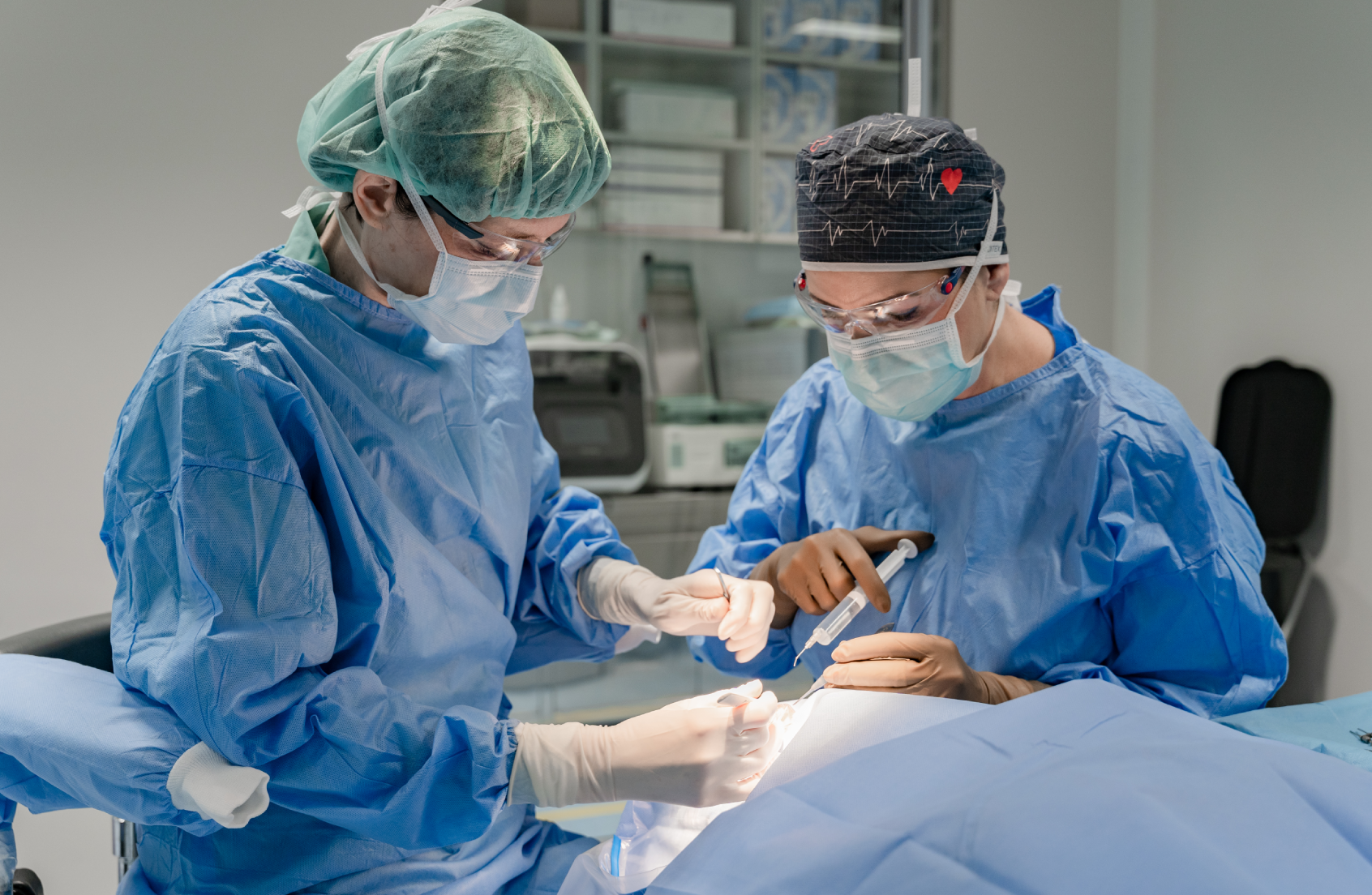
Strabismus surgery is performed under general anesthesia and, depending on the complexity of the procedure, lasts from 30 to 90 minutes. Patients come to surgery fasting, with laboratory results required for anesthesia. Before the procedure, the anesthesiologist discusses the child’s general health, previous illnesses, and reviews the results to confirm readiness for surgery.
The goal of surgery is to position the eye correctly. This is achieved by adjusting the eye muscles, weakening or strengthening them, depending on the type and degree of strabismus. During the procedure, the muscle insertion is changed, the muscle can be shortened, split, or an additional insertion can be created to achieve the appropriate balance of forces acting on the eye. Where more complex correction is needed, we also use techniques such as Y-splitting, muscle transposition and, occasionally, a graft made from bovine pericardium (the membrane that surrounds a cow’s heart).
In cases of eye muscle paralysis, i.e., reduced eye motility, fibers from surrounding healthy muscles can be joined to the paralyzed muscle to improve its function.
Surgery aims to enable better eye alignment and easier maintenance of gaze in the same plane.
What does recovery look like?
After strabismus surgery, most patients go home the same day, while if necessary, especially in children, a short stay at the clinic until the first follow-up may be recommended. In that case, a parent can stay with the child in the hospital room during postoperative recovery. In most cases, children leave the clinic a few hours after the procedure.
The first follow-up is performed the day after surgery, while further follow-ups are scheduled depending on the type of procedure, usually at intervals of one to two weeks. Typically, the second follow-up is performed after one week, and the third one month after surgery.
In the early postoperative period, which lasts up to seven days, discomfort, eye redness, and light sensitivity are common. It takes about two weeks for the wound to heal completely and for the eye to become completely white again, and in some patients it may take up to a month.
After the procedure, your child will wear a patch until the first follow-up appointment. Try to make sure they do not pull it off or rub their eyes. For two to three weeks after surgery, it is necessary to regularly apply the prescribed eye drop therapy. In children, it is particularly important to pay attention to proper application of therapy because children often reflexively close their eyelids during instillation.
During the recovery period, it is recommended to avoid heavy exercise, swimming, and smoky places. Children usually return to kindergarten or school after two weeks, while adults, depending on the type of work, can return to daily activities earlier, often after seven days for office work.
06