Blog
Do you know when’s the right time to take your child to an ophthalmological examination?
Most common eye diseases and conditions that can decrease visual acuity in children are refractive errors corrected by optical or contact lenses, and strabismus (unnatural eye position, skewed eyes). Many of visual disturbances in childhood are treated simply if detected on time.
Vision is extremely important and isn’t fully developed with birth. Visual stimulus begins intensive vision development just after birth. When children reach the age of 3, parents are the ones who should take them to a preventive, routine examination to the ophthalmologist, no matter that seemingly everything is in perfect order.
When parents think about children’s good vision, mostly, they think about how clear they can read while the examination lasts.
Parents often say a child sees even bread crumbs on the carpet, forgetting that the child is looking with both eyes simultaneously when the most important thing is to examine vision specifically for each eye. Also, assessment of visual acuity does not determine the other aspects of the vision needed for children to function normally in all aspects of everyday life, mostly at school. Those are, for instance, coordination of the eye movement and possibility to focus (accommodate) while looking close by, then the existence of binocular vision, the absence of strabismus and so on.
Symptoms and signs to raise suspicion of eye diseases in children are:
- white pupil
- the child doesn’t notice or doesn’t follow objects or toys with eyes
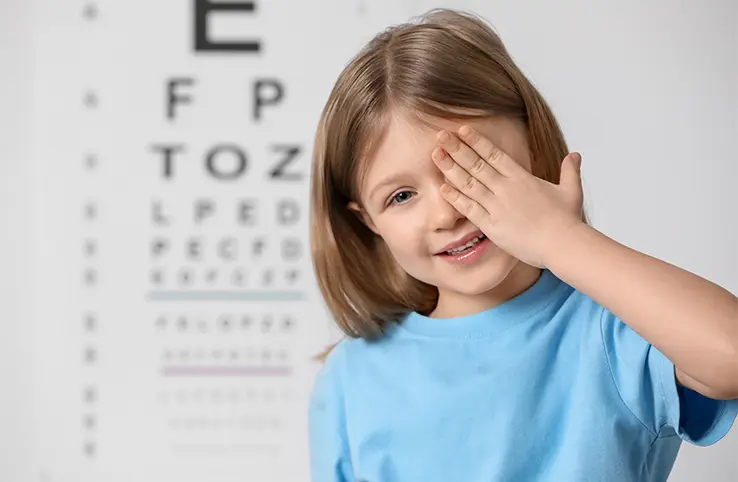
- child squints, covers one eye with a hand, tilts his head
- unnatural position or mismatched eye movement (strabismus)
- spontaneous, rhythmic eye twitches (nystagmus)
- excessive tearing and redness of the eyes, often rubbing the eyes
- fatigue, headache or dizziness when reading, quick tiredness when reading
- getting too close to a TV screen
Most common eye diseases and conditions that can decrease visual acuity in children are refractive errors corrected by optical or contact lenses, and strabismus (unnatural eye position, skewed eyes). Other possible causes of poor vision are blurring of the eye lens (cataract), glaucoma (high eye pressure), eye injuries (often children do not say they have been injured), corneal diseases, retinal and visual nerve diseases, tumours (retinoblastoma) and some hereditary disorders.
The child’s ophthalmologic examination lasts for up to two hours and includes:
- determination of near and distance visual acuity
- tests for strabismus and stereopsis
- pupil dilation and objective diopter determination
- a complete overview of the front and back eye segment.
Many of the visual disturbances in childhood are simply treated if they are diagnosed on time. At the Svjetlost Clinic, an ophthalmologic examination is adapted to the child’s age, doing our best to make it more interesting for the children.
Istražite naše novosti i stručne blogove
News & Expert advice
-
![]()
News
Svjetlost Eye Clinic at the 44th ESCRS Congress
Leading world ophthalmologists in London.
-
![]()
News
When is the best time for laser vision correction?
Dr. Ivan Gabrić reveals whether there is an ideal time of year for the procedure.
-
![]()
News
New Academic Title for Prof. Maja Bohač, MD, PhD
A success that deserves attention. Congratulations!