
Blog
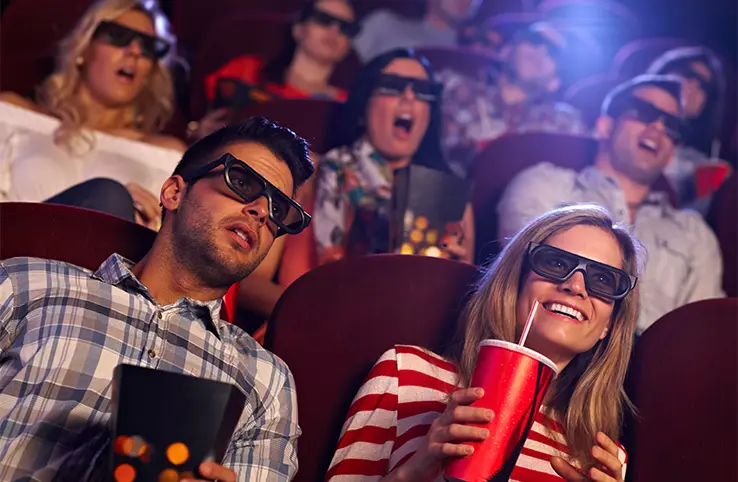
Did you know how 3-D movies are affecting your eyes?
According to recent knowledge, without long-term studies, there are no indicators that show the harmful effect of 3-D movies on your vision.
3-D movies have become more popular so the question of effect on your eyes, especially on your kids’ eyes occurs frequently. Is there a harmful effect on eyes?
3-D movies produce 2 different pictures on the screen which are at the set distance to enhance the perception of depth. Without 3-D glasses, which are filtrating the light and are showing different pictures to each eye, a picture on the screen is blurry. People have 3-D vision (they see in 3 dimensions) thanks to 6.3 cm distance between eyes. We use both eyes for depth perception. Our brain implements a slightly different view that each eye sees when looking at objects and it’s how the third dimension is made. To see 3-D, eyes need to perform simultaneously and in a coordinated matter. Approximately 5% of people cannot see 3-D because they are monocular, use only one eye for watching due to low vision or some disease or eye injury. Around 35% of people have limited binocular vision (looking with 2 eyes) which means they can use both eyes to see 3D, but with difficulty.
According to recent knowledge, without long-term studies, there are no indicators that show the harmful effect of 3-D movies on your vision. Some people feel a headache and nausea when watching 3-D movies, which are mostly consequences of focus problems or perception of depth for the viewer. On the other side, for some people, a 3-D effect can be confusing to the brain and cause confusion while watching although vision is normal.
For children younger than 6, it is recommended to avoid longer watching of 3-D movies or video games in order to prevent possible damage of visual development. If the child complains to a headache, eyes fatigue or blurrier vision while watching 3-D movies or games, there is most probably a vision problem, and it’s recommended to make a detailed ophthalmologic examination.
No research has been made so far on 3-D digital products effects on eye and visual developments in children, and it’s unknown which was said products could cause eventual damage in children with healthy eyes. However, it’s not recommended longer watching of 3-D movies for children with low vision or strabismus who have problems with depth perception or normal 3-D vision because there is a bigger possibility of a headache and/or eye fatigue.
Istražite naše novosti i stručne blogove
News & Expert advice
-
![]()
News
ACI Interview: Dr Ivan Gabrić & Dr Krešimir Gabrić
Patient trust built on high professional standards.
-
![]()
Blog
You Could Develop Cataracts Much Earlier Than You Think
Ante Barišić, MD, PhD, talks to MISS7ZDRAVA about eye health in the digital age
-
![]()
News
EASE – a new surface laser vision correction method at Svjetlost Eye Clinic
Svjetlost Eye Clinic now offers its patients EASE, the newest method of laser vision correction. EASE (Epithelial All-femtosecond Surface Excision) was developed by the German company SCHWIND eye-tech-solutions and is performed with the SCHWIND ATOS® laser.