Blog
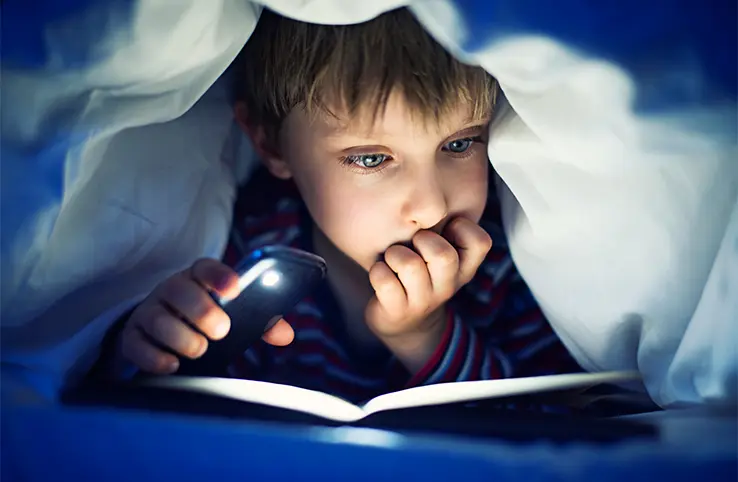
Should children read in the dark?
Under muted light conditions, exertion of eye muscles is greater so blurred vision eye and eyelid irritation, headachek, neck pain and sometimes even nausea are not rare.
Most children caught reading in the dark or under the lamp are going to be warned by the parents about how they will ruin their eyes and will have to wear glasses because of this bad habit. However, it’s not scientifically proven. What one can experience while reading in the dark or in muted light is brief eye strain that lasts mainly until we take a rest, but it doesn’t cause permanent damage to the eyes.
It is assumed that eye strain during reading time in the dark occurs because the eyes receive mixed signals. Namely, our eye is a perfect small camera adapting to the amount of light and distance of the subject we are looking at, in order to make the image as clear as possible and to get a clearer impulse into the brain. Majority is done unconsciously, we’re in fact not even aware that anything is happening at all. It is necessary that our vision is extremely sharp when we read and there are some reflexively changes in the eye in order to bring the light to the point of the clearest vision, the yellow spot, (macula) which contains cone cells.
The pupil constricts and the natural lens protrudes more due to muscles contraction inside the eye. When we are in dim light conditions, opposite changes occur – the pupils are dilating, and the natural lens relaxes for more light to reach the cells on the periphery of the retina that are more sensitive to watching in the dark (rod cells). Therefore, when reading in the dark, the eye will receive two contradictory orders, so it can’t completely fulfil none of the functions. Additionally, in muted light conditions, the contrast between the page and the letters is smaller, causing additional effort. Because of all this, eye muscles exertion is greater so greater so blurred vision, eye and eyelid irritation, headache, neck pain and sometimes even nausea are not rare. Luckily, after rest, the symptoms disappear without lasting consequences.
In some cases, reading in the dark is associated with an increased risk of developing short-sightedness in children and adolescents. Although for a time this theory was popular and a reason for many discussions and researches, the generally accepted stance of most researchers is that short-sightedness is genetically conditioned. Although according to various researches, genetics is responsible for 85-100% of short-sightedness, it is not necessary to completely ignore the environmental factors.
So, when we are reading it is recommended to provide sufficient lighting, whenever possible daylight. If we have a flashlight it is better not to have only one light source directly directed to the book. It will be easier to read if the contrast is smaller, that is if we have a dim light in the room plus an additional stronger source that illuminates the book we are reading. That’s why it’s best to talk to our teenagers and agree that secret reading under bedsheet is not the best solution.
Istražite naše novosti i stručne blogove
News & Expert advice
-
![]()
News
Prof. Maja Bohač at the 2nd ARSM in Ljubljana
Prof. Maja Bohač, MD, PhD, Head of the Department of Refractive Surgery at Svjetlost Eye Clinic, gave an invited lecture titled “Current State of Lenticular Extraction” at the 2nd Alps Refractive Surgery Meeting (ARSM).
-
![]()
News
Croatian surgeon becomes second in the world to perform a new laser vision correction method
That’s why more and more people are considering laser vision correction. But some have already been told at an eye exam that they aren’t good candidates because their prescription is too high or their cornea is too thin. For some of them, there is now a new solution.
-
![]()
News
Svjetlost tests the reliability of advanced vision diagnostics across more than 30,000 scans
A scientific paper by Ivan Gabrić, Ivan Samuel Modrić and Filip Grulović, based on a registry of 2,533 eyes, shows how important standardised image acquisition and quality control are for a reliable assessment of the eye's optics.